
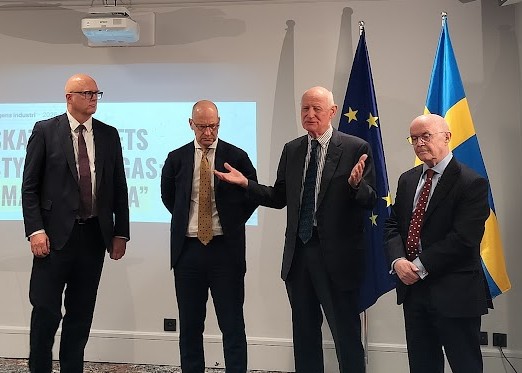
Brussels, 18 November 2026 – International lawyers representing Swedish businessman Ola Nordquist presented complaints against the State of Sweden at a press conference in Brussels today, arguing that his long-running tax dispute has exposed serious shortcomings in due process and the rule of law.
Nordquist, a former Nordic head of the private equity firm Permira, has been engaged in a multi-year conflict with the Swedish Tax Agency (Skatteverket) concerning the taxation of carried interest. He claims the combined effect of assessments resulted in an effective tax burden of approximately 125 per cent. According to his representatives, the agency initially declined to clarify whether certain income should be treated as capital or employment income, after which Nordquist paid taxes on both bases. Subsequent court decisions ordered partial refunds that the agency has not fully implemented, leading at one point to enforcement action by the Swedish Enforcement Authority (Kronofogden) against the state itself.
Skriver i Bulletin om fallet Ola Nordquist och aktivistkulturen på Skatteverket. https://t.co/NWPWzcWl0H
— Pontus Andersson Garpvall (@SdPontus) March 4, 2026
The lawyers further allege double taxation of the same income in Sweden and the United Kingdom, as well as violations of the EU General Data Protection Regulation (GDPR) in connection with the handling of Nordquist’s personal data. They also contend that the proceedings breached Article 6 of the European Convention on Human Rights, which guarantees the right to a fair trial.
At the Brussels event, British King’s Counsel Steven Kay, who is leading the international legal team together with Kenneth Carr and Swiss lawyer Sylvain Savolainen, stated that “the State has a greater obligation in terms of fairness.” He further alleged that “the Swedish Tax Agency has intentionally taken taxes outside the permitted laws of Sweden and this does not only relate to Nordquist.”
Addressing the claimed tax rate directly, Kay added: “Effectively, as a citizen, Ola Nordquist was paying all of his earnings for the privilege to remain in business. That is the only way to look at a 125 per cent tax burden.”
Another member of the legal team remarked that “administrative courts do not function the way they should,” referring to the handling of the domestic proceedings.
HELT JÄVLA OTROLIGT.
Riv kammarrätten, salta dess jord och sparka varenda jävla tomte.
Skatteverkets loggar visade att över 80 anställda på skatteverket gjort slagningar (läs dataintrång) i företagaren Ola Nordquist i deras system. Åklagare startade förundersökning direkt.
När…
— Hanif Bali (@hanifbali) October 16, 2026
The complaints lodged with the European Court of Human Rights and with two UN Special Rapporteurs (on privacy and on the independence of judges and lawyers) raise several issues. These include claims that at least 89 Tax Agency employees accessed confidential documents subject to absolute secrecy, that details of Nordquist’s personal finances appeared on the agency’s intranet, and that access logs previously disclosed to him are now said to be unavailable. Nordquist’s team also contends that judges who are married to each other participated in related proceedings despite his objections on grounds of bias. Swedish courts, including the Administrative Court of Appeal, have rejected the bias challenges.
Skatteverket, Sweden’s tax office, has previously maintained that its assessments were lawful, that investigations into unauthorised access found no irregularities, and that criminal inquiries concerning senior officials (including the former Director-General) were discontinued. The agency has stated that it is prepared to discuss the matter once all domestic tax proceedings are concluded.
Writing for Bulletin, Swedish SD MP Pontus Andersson Garpvall comments: “It both sounds and is completely absurd. All major media have reported on the case. The affected business owner, Ola Nordquist, is probably the only venture capitalist in world history who has [received support from Åsa Linderborg at Aftonbladet] in a dispute with the state. But the Tax Agency claims that it is in the right and that the criticism against the agency is an “unlawful influence campaign.” When Dagens Industri asked what the campaign consists of, who is behind it, and why it has not been reported to the police if it is unlawful, the Tax Agency refused to answer.
This is therefore not about political opinions. The criticism of the Tax Agency comes from both the right and the left. Everyone understands that one cannot pay 125 percent in tax, and no one thinks a government agency should be allowed to defy court decisions.”
The European Court of Human Rights has not yet ruled on the admissibility of the applications. The case continues to attract attention in Sweden, where it has been debated in the media and in parliamentary committees, primarily over questions of administrative procedure, secrecy obligations and the limits of tax authority discretion.