
By Pieter Cleppe
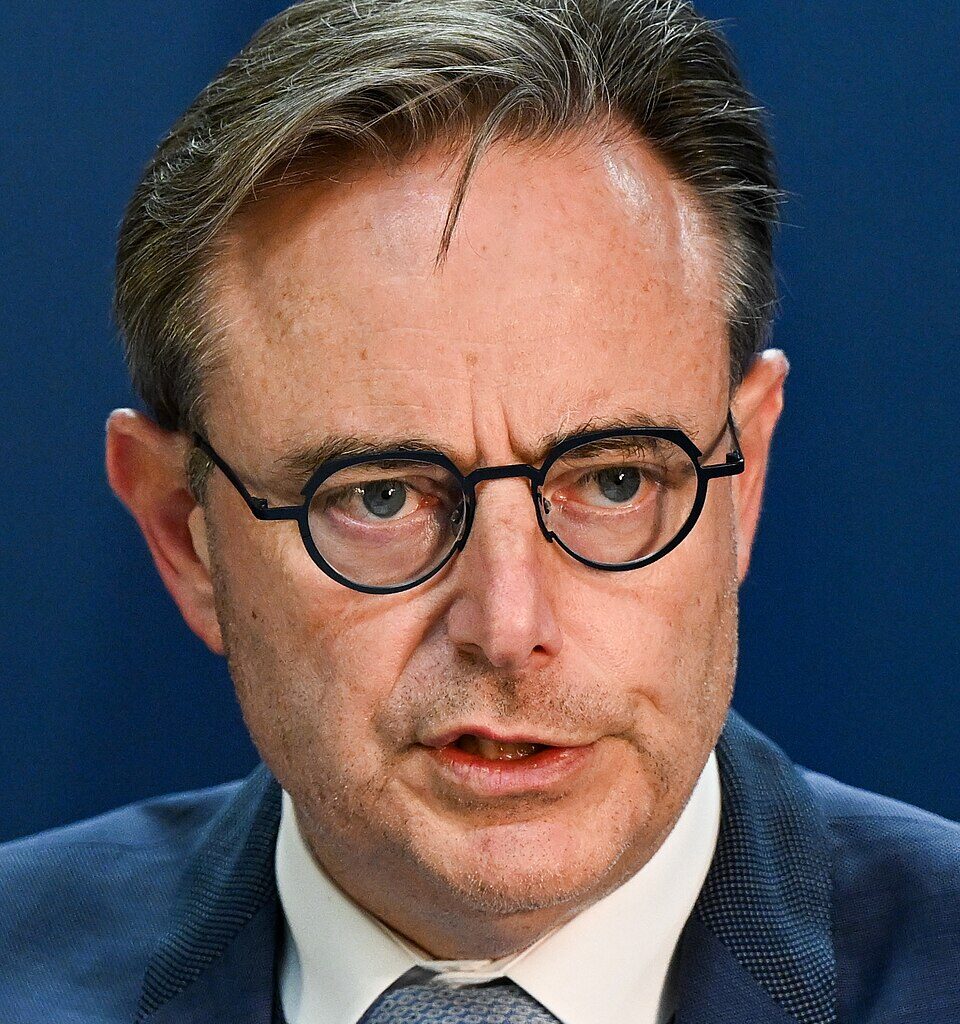
The EU summit that blocked the Ukraine loan plan championed by Ursula von der Leyen and Friedrich Merz was widely framed as a setback for European unity. In reality, it was something else entirely: a rare moment where escalation was paused before doing lasting damage. Belgian Prime Minister Bart De Wever (picture) emerged from the summit with a quiet but significant win — not because Europe is doing too little for Ukraine, but because it narrowly avoided doing something profoundly reckless.
Joint EU borrowing already pushes the Union further toward fiscal centralisation than many voters ever approved. But that debate pales in comparison to what was almost normalised next: undermining the legal foundations of Europe’s financial system by manipulating the treatment of sovereign assets held at Euroclear. That would not just have been controversial — it would have been corrosive.
Yet even without crossing that final line, the EU has already crossed another one: treating the Treaties as optional when political pressure mounts.
A big win for Belgian PM @Bart_DeWever at #EUCO. Still, more joint EU debt amounts to dangerous centralisation, but this is not as bad as a reckless de facto confiscation of central bank assets at Euroclear, which is key to the global financial system. https://t.co/q3dHnOARaz https://t.co/ictwMjwkxw pic.twitter.com/6Dj04t7gdi
— Pieter Cleppe (@pietercleppe) December 19, 2025
Undermining the rule of law
While peace discussions around Ukraine drag on, the EU quietly rewrote its own decision-making rules. The Council agreed to extend the freeze on Russian assets by qualified majority voting, replacing the unanimity requirement that has always applied to sanctions-related measures.
This procedural change is not a technical footnote. Hungary and Slovakia were overridden. The European Parliament was excluded. And the Common Foreign and Security Policy framework — designed precisely to prevent such manoeuvres — was effectively bypassed.
Belgium’s role as host to Euroclear, which holds the lion’s share of the frozen assets, is often portrayed as the central issue. It is not. The real problem lies elsewhere: the deliberate stretching of EU law beyond its limits, with the consent of Member States who know better.
More here. As far as I understand, the EU merely states it "reserves the right" to use the Central Bank assets in case Russia does not pay back Ukraine. But ultimately, the decision to use those or not has not been taken, and EU budget is the real collateral, with privilege for…
— Pieter Cleppe (@pietercleppe) December 19, 2025
“I think she did an excellent job.” om daarna impliciet te zeggen dat von der Leyen een keizerin zonder kleren is. "She senses" just niks. pic.twitter.com/H4eNmrZ8H4
— Inge NWN®™ (@IENouwen) December 19, 2025
Article 122 as a legal fig leaf
To justify this shift, the European Commission reached for Article 122 TFEU, arguing that an “economic emergency” required urgent action. This article exists to deal with supply shocks — particularly in energy — not to conduct foreign policy by stealth, with EU member states following suit.
The Commission’s claim that preventing funds from returning to Russia is necessary to protect the EU economy may sound plausible at first glance. Legally, it is deeply problematic.
As legal scholars have pointed out, freezing a third country’s sovereign reserves is a restrictive foreign-policy measure, governed by Article 215 TFEU — which explicitly requires unanimity. Article 122 is simply not designed for this purpose.
This is why it is so controversial. And this is why everyone involved knew exactly what they were doing.
Belgium eventually accepted the move, not out of conviction, but out of self-preservation. If the Commission later succeeds in leveraging these assets, a single veto from another Member State could expose Belgium to enormous financial and legal risks. Prime Minister De Wever warned of this explicitly.
This pattern is familiar. Germany’s Constitutional Court raised similar alarms about the use of Article 122 for the Covid Recovery Fund in 2022. The EU Court of Auditors later echoed those concerns. None of this stopped the machine.
Jean-Claude Juncker once captured the Brussels mindset perfectly: “When things get serious, you have to lie.” Accusations of “Rechtsbruch” were brushed aside during the euro crisis. They are brushed aside again today. The EU’s own court, predictably, shows little interest in intervening.
Joint European debt
For the Commission’s plan to use frozen Russian assets as collateral for a Ukraine loan — the so-called “reparations” approach – Article 212 TFEU was floated as a legal basis, which is cleaner. Politically, however, the plan was ultimately shut down at the EU summit.
Belgium had signalled conditional openness, but only if other Member States provide explicit bilateral guarantees. Germany was willing. Most others were not. Belgium’s fallback option. Italy’s alignment with Belgium ultimately delivered the deal to go for joint European debt instead.
The new approach avoids eroding the rule of law, avoids placing Belgium in legal jeopardy, and avoids sending a global signal that Europe is no longer a safe place to park sovereign assets. It is no coincidence that non-Western central banks have been stockpiling gold since the Russian assets were frozen in 2022. It does come with risks, as joint European debt does, but for the first time, there are countries enjoying an opt-out of this. That is a precedent that may exploited again in the future, reducing the risk of joint European debt somewhat.
Fair point, but the alternative of Euroclear Central Bank asset confiscation was much more risky. In an ideal world, governments do not need to take out debt to support Ukraine.
This new "eurobond" is interesting, however, as 3 EU member states (CZ-SK-HU) enjoy an opt-out. That…
— Pieter Cleppe (@pietercleppe) December 19, 2025
Sanctions fail
The real disagreement in Europe is not about whether to support Ukraine, but about which tools actually help.
Financial and military assistance has made a tangible difference. Ukraine has held Russia at bay without triggering a direct NATO–Russia conflict. The countries contributing most are those geographically closest to Russia — a reflection of democratic support shaped by history and proximity.
Sanctions tell a very different story.
Despite 19 EU sanctions packages, the Russian ruble has surged this year and now trades near a three-year high. Yes, Russia’s budget is under pressure — but war spending remains Putin’s top priority. Sanctions rarely change that calculus.
Trade diversion has flourished. Central Asian states have become transit hubs. Turkey, a NATO ally, is now among the largest buyers of Russian fossil fuels. The pattern is familiar from decades of sanctions elsewhere: populations suffer, regimes adapt, and geopolitical outcomes barely move.
Agathe Demarais documents this dynamic in Backfire, showing how modern sanctions incentivise circumvention and innovation rather than compliance. Russia is simply following the script.
More sanctions, this time on Fertiliser?
Few examples illustrate sanctions backfiring as clearly as fertiliser.
Before the invasion, Europe operated around 120 fertiliser plants, covering roughly 70% of nitrogen demand. Many relied on Russian gas or ammonia. When pipeline gas flows stopped and prices soared, EU fertiliser production collapsed by around 70%. Only about half of that capacity has since returned.
The consequence is perverse but undeniable: Europe now imports more Russian fertiliser for certain products than before the war.
Despite this, there are calls to sanction fertiliser. This however ignores the damage already inflicted. In March 2022, uncertainty alone forced EuroChem to shut its Antwerp plant, idling nearly 400 workers and halting BASF-linked supply chains. It took months for Belgian authorities to confirm the company was not sanctioned.
Farmers would bear the brunt of further restrictions. Fertiliser represents 15–30% of their input costs. After years of rising expenses and falling prices, farmer protests paralysed European capitals in 2024. Brussels knows that disrupting fertiliser supply again risks another political explosion — one that is already brewing, with tens of thousands of farmers expected to protest this week.
The Economist notes that the reason why the EU has not yet imposed sanctions on fertiliser imports is “largely down to its beleaguered farmers. Fertilisers constitute 15-30% of their input costs. Those costs rose significantly between 2020 and 2025 due to the covid pandemic and wars in Ukraine and the Middle East. Meanwhile grain and produce prices have fallen. In 2024 protesting farmers drove convoys of tractors into several European capitals, including Brussels. The EU fears that disrupting the fertiliser supply would again expose it to their wrath.”
As 10.000 farmers rallied in Brussels during the EU summit, extra sanctions for fertiliser may not exactly make them any happier, especially as the EU would embark on this without enabling European domestic fertiliser production. For that, it is not only necessary to drastically lower EU energy prices, which requires scrapping large parts of EU climate policy, in particular the climate taxation scheme ETS. The Economist notes that at the moment, “investors are reluctant to back more European production, in part because of the EU’s costly environmental rules.” Using the chainsaw of deregulation is therefore the absolute prerequisite to do this responsibly.
Replacing Russian fertiliser is not straightforward either. Imports from Egypt or Algeria will become more expensive once the EU’s Carbon Border Adjustment Mechanism (CBAM) kicks in. Farmer lobbies warn that CBAM will drive up costs and uncertainty at precisely the worst moment.
Here, EU climate policy actively undermines both sanctions policy and agricultural stability. Investors hesitate to back European fertiliser production because energy remains expensive and environmental rules are heavy. Without cheaper energy and serious deregulation, sanctioning fertiliser would be reckless.
Russian nitrogen fertiliser = a larger share of the European market today than in 2021 (33%) while European & UK production has collapsed due to high energy costs.
‘Europe bans Russia’s gas exports, but still buys its gas-based fertiliser’https://t.co/he27g1EwuC
— Joe Stanley (@JoeWStanley) December 13, 2025
A step in the right direction
Europe proclaims its commitment to the rule of law, yet considers to weaken it when decisions become uncomfortable. It escalates sanctions that do not work, while hesitating on support that does. It centralises authority while eroding trust — both inside the Union and beyond it. At least, deciding to shy away from confiscation of Central Bank assets is a step in the right direction.
Copyright picture: © European Union, 1998 – 2025, Attribution, via Wikimedia Commons